
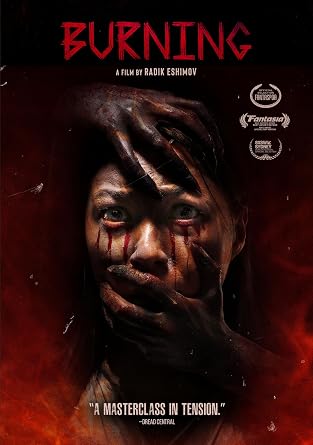
A young family has just buried their firstborn son. In the weeks that follow, the mother wanders from door to door, pleading for help no one understands, then vanishes into the trees at the forest’s edge. The father’s mother arrives, uninvited, unexplained. And then, one night, the house is consumed by fire. What happened inside stays inside — except for what the neighbors think they saw. At the village shop, three witnesses trade fragments of the same night, and each fragment curdles into something darker than the last. A curse, some whisper. Others say it was grief itself, turned monstrous. Every retelling shifts the blame to a different member of the family, and every new detail makes the ones before it feel like lies. By the time the full picture assembles, the line between what happened and what the village needed to believe has dissolved entirely. And somewhere between fact and folklore, in the space no single witness can see, the real horror is waiting — patient, and closer than anyone thought.
What I Thought:
Burning is told in three acts. I liked the first two acts, but the third act feels like a cop out for an American audience. I’ll explain what I mean when I get to the third act section. The three acts are told through different perspectives with each version making what happens appear to be someone else’s fault.
The gist of the movie is that there is a husband and a wife who lost a child. She believes she’s pregnant again. He believes there’s something wrong with her. His mother arrives and depending on which act it is, she comes across as awful or concerned.
One act blames the events on the mother/mother-in-law. One of the storytellers blames her for the fire because she puts a curse on them or is some sort of spiritual/supernatural type. One act blames the wife. They think she’s lost it because of the death of the son and is only pretending to be pregnant. She might be possessed by a jinn.
The third act is portrayed as the truth and here is where I have an issue with the film. It’s going to be hard to explain without spoiling, but I’ll do my best. The person who gets the blame in the “truth” feels like a cop out because I’m American. Hollywood has gone this route for decades now. I get that in their religion and country blaming this person and having this be the reason behind everything is probably taboo and is very glass ceiling breaking, but as an American, it takes away from the entire film being a supernatural/psychological thriller.
Burning is probably a groundbreaking, momentous film in its homeland and for two thirds of the film I didn’t mind it, but the third act seems lame (as an American). I understand the cultural norm it’s going against and will respect the film for what it’s doing, but in terms of entertainment factor, it lost all its momentum in the third act to me.

